AI agents are quickly changing what businesses expect from artificial intelligence. A traditional chatbot waits for a question and produces an answer. An AI agent can go several steps further: it can interpret a goal, find relevant information, call software tools, coordinate with other systems and continue working until a task is complete. Modern agent frameworks are consequently being designed around tool use, memory, orchestration, approvals and multi-step execution rather than simple one-prompt, one-response interactions.
That makes AI Infrastructure much more important than it may first appear.
The glamorous part of agentic AI is usually the model. The practical part is everything sitting underneath it. An impressive agent running on weak infrastructure is rather like putting a Formula One engine into a shopping trolley: there is plenty of intelligence and horsepower, but the surrounding system cannot safely make use of it.
For businesses, infrastructure now has to do more than provide computing power. It must connect agents to trusted data, manage memory, authenticate users and agents, control what tools they can access, monitor every important action and stop risky activity before it becomes a very efficient mistake. AWS’s latest guidance for agentic systems, for example, treats compute, memory, orchestration, security, observability, evaluation, identity and policy as interconnected parts of production agent architecture.
What AI Infrastructure Means in the Agentic Era
AI infrastructure traditionally referred largely to the computing, storage and networking resources required to train and run machine-learning systems. Agentic AI expands that definition because an agent is not simply generating an output; it may be interacting continually with databases, business applications, APIs, other agents and users.
A useful way to think about modern infrastructure is as the operating environment for AI decisions and actions.
A production agent commonly needs access to a model for reasoning, enterprise information for context, short- or long-term memory, software tools through which it can take action, and an orchestration layer that determines what happens next. Enterprise architecture also increasingly includes agent identities, policy enforcement, audit logs, evaluations and human approval points.
Open standards are becoming part of this foundation too. Anthropic introduced the Model Context Protocol (MCP) as an open method for connecting AI applications with data sources and tools, reducing the need for separate custom integrations. Google subsequently introduced Agent2Agent (A2A) to support communication and coordination between agents built on different technologies.
Those developments point towards an important architectural principle: businesses should avoid designing an agent ecosystem in which every model, tool and application is permanently welded together.
The model will change. The CRM may change. The agent framework almost certainly will.
Your underlying architecture should be able to survive all three.
Useful technical references include the AWS Agentic AI Lens, Anthropic’s Model Context Protocol and OpenAI’s Agents SDK documentation.
The Core Infrastructure Behind Reliable AI Agents
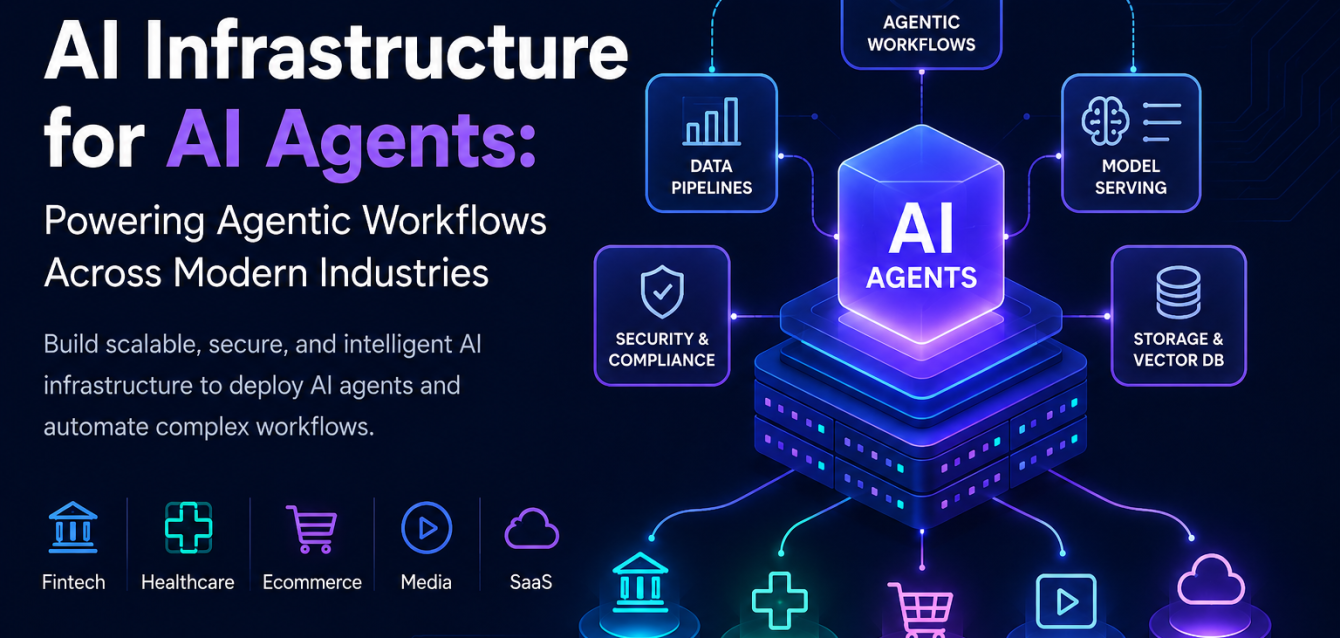
Agentic infrastructure is best understood as a stack rather than one product.
| Infrastructure layer | What it does for an AI agent | Why it matters |
| Compute and model runtime | Runs foundation models and specialised models | Determines response speed, availability and scalability |
| Data and knowledge layer | Gives agents approved business context | Helps answers and actions reflect current organisational information |
| Memory | Preserves relevant state between steps or sessions | Supports longer, multi-stage workflows |
| Tools and integrations | Connects agents with applications, databases and APIs | Turns AI from an answer engine into an action engine |
| Orchestration | Coordinates steps, agents and hand-offs | Keeps complex workflows organised |
| Identity and permissions | Controls who or what can perform particular actions | Limits the consequences of mistakes or misuse |
| Observability and evaluation | Records behaviour and tests results | Helps teams identify failures and improve quality |
| Human oversight | Requires people to approve sensitive operations | Keeps responsibility around important decisions |
This layered approach closely reflects emerging production architectures from AWS and Google Cloud, both of which separate runtime, tools, memory, identity, governance, security and observability rather than treating an agent as a single application.
The data layer deserves particular attention. Agents become useful when they can work with your organisation’s actual information rather than relying entirely on what a general-purpose model learned during training. Retrieval systems and enterprise knowledge stores can supply that context while access controls restrict what an agent is allowed to retrieve.
Then comes tool access. This is where the stakes riseAn agent that can read a product catalogue presents one level of risk. An agent authorised to issue refunds, modify medical information, delete records or change production software presents another. Australia’s cyber security agencies therefore recommend that organisations avoid giving agentic systems broad or unrestricted access and instead apply role-based identity controls, strict boundaries and human intervention points.
How Agentic Infrastructure Supports Healthcare, Ecommerce, Media and SaaS
The same architectural principles can support very different industries, but the business requirements change considerably.
Healthcare requires exceptionally careful handling of data, system integration and human oversight. Agents can support administrative workflows, information retrieval, documentation and operational coordination, but the underlying infrastructure must protect sensitive information and integrate cleanly with existing health systems. Australia’s Digital Health Agency says consistent standards and interoperable digital infrastructure are important foundations for secure, clinically safe information sharing and appropriate AI use.
That makes standards such as FHIR and consistent clinical terminology relevant to the wider AI conversation: an agent cannot reliably coordinate health information if the underlying systems cannot consistently describe or exchange it.
Ecommerce presents a different challenge. Here, agents may need access to live product information, inventory, pricing, shipping options, payments and order systems. Shopify’s emerging agentic-commerce architecture illustrates this shift: its Universal Commerce Protocol is designed so AI agents can discover merchant capabilities and participate in commerce workflows across catalogue, checkout and order functions without every agent requiring a completely bespoke integration.
The infrastructure lesson is larger than Shopify itself. Ecommerce agents need structured, current and permissioned data. A beautifully written AI recommendation is of little value when it recommends the jacket that sold out on Tuesday.
Media and marketing put greater emphasis on content, brand governance, customer data and approval workflows. Adobe’s current enterprise agent architecture, for example, is designed around agents operating with business context, permissions, auditability and reusable workflow logic rather than independently generating content with no organisational controls.
For Australian media organisations, the provenance of content is also becoming more important. In July 2026, the Australian Government established an Office of AI and announced work on new Australian AI standards alongside stronger protections concerning the use of Australian creative works in AI training.
SaaS businesses, meanwhile, are well placed to embed agents directly into existing workflows. Australian-founded Atlassian, for instance, is expanding Rovo around agents that work across Jira, Confluence and connected applications, supported by organisational context, permissions, testing, analytics and governance controls.
Across all four sectors, the pattern is remarkably consistent:
Models provide intelligence. Infrastructure provides context, access, control and continuity.
The Office of the Australian Information Commissioner states that Australian privacy obligations can apply both to personal information placed into AI systems and to AI-generated outputs containing personal information. It recommends due diligence around commercially available AI products, including examining privacy risks, security, human oversight and who can access information processed by the system.
That makes data architecture a boardroom issue rather than merely an engineering preference.
An organisation should know where sensitive information enters an agent workflow, which model receives it, what gets retained in memory, which tools can act upon it and what records exist afterwards. The Australian Government’s AI guidance similarly emphasises accountability, risk management, data governance, testing, human control and transparency.
Cyber security raises another consideration. The Australian Signals Directorate’s 2026 agentic AI guidance recommends restricting autonomous systems to appropriately low-risk tasks, enforcing agent identities and permissions, creating oversight mechanisms and applying defence in depth across information entering and leaving an AI system.
At the physical-infrastructure level, Australia’s policy environment is moving quickly too. In March 2026, the government published expectations for data centres and AI infrastructure developers covering national interest, energy, water efficiency, Australian skills and local research capability. In July, the newly created Office of AI was tasked with developing standards that are expected to include mandatory requirements for large AI data centres.
For businesses selecting infrastructure partners, that means questions about security, locality, resilience, energy use and governance deserve a place alongside questions about raw computing performance.
Building the Right Base Infrastructure for AI Agents
Useful Australian references include the OAIC guidance on AI and privacy, the ACSC guidance on agentic AI and the National AI Plan.
In this article, I use Baseinfra for AI infrastructure to mean the foundational layer beneath your agents: compute, networking, storage, data access, runtime services, identity, integrations and monitoring.
The important point is that you do not necessarily need to build every layer yourself.
Modern platforms increasingly offer managed agent runtimes, memory, observability, identity, gateways and evaluation tools. AWS, Google Cloud and specialist agent frameworks all reflect the broader move towards modular infrastructure in which organisations can manage some components internally while consuming others as managed services.
A sensible selection process starts with the workflow rather than the model.
Ask what the agent must read, what it must remember, what it is allowed to change, which actions require a person’s approval and what evidence you will need afterwards to explain what happened. Those questions map directly to data access, memory, permissions, approval gates, logging and observability.
You should also favour architectures that preserve flexibility. MCP is designed to standardise connections between AI applications and tools, while A2A targets communication between agents. These protocols do not eliminate integration work, but they demonstrate the industry’s movement towards more interoperable agent infrastructure.
Finally, test the complete workflow rather than judging only the model’s answers. Agent reliability depends on much more than model accuracy: tool failures, incorrect permissions, stale data, failed hand-offs and unexpected sequences of actions can all affect the final result. Production guidance from AWS and OpenAI therefore places tracing, evaluations, guardrails and approvals alongside model selection itself.
The model may be the brain, but infrastructure is the nervous system, memory, security desk and fire exit.
Frequently Asked Questions
What is AI infrastructure for AI agents?
AI infrastructure for agents is the combination of computing resources, models, data systems, memory, integrations, orchestration, identity controls, security, monitoring and governance that allows AI agents to perform multi-step tasks reliably. Modern reference architectures increasingly treat these functions as separate but coordinated layers.
How is agentic AI different from a normal chatbot?
A conventional chatbot generally responds to user prompts, whereas an agent can operate through a continuing workflow: reasoning about a task, using tools, retrieving information, maintaining state, handing work to another agent and pausing for approval where necessary. The exact degree of autonomy depends on how the system is designed.
What should Australian businesses prioritise when deploying AI agents?
Security and governance should be designed in from the beginning. Australian guidance particularly supports controlled permissions, human oversight, privacy due diligence, risk assessment, testing and monitoring. Businesses handling personal or sensitive information should also carefully examine where data travels, how it is retained and who can access it.
Conclusion
The next phase of enterprise AI will not be defined solely by models that can produce more impressive answers. It will increasingly be defined by systems that can safely turn intelligence into action.
Across healthcare, ecommerce, media and SaaS, the recurring requirements are remarkably similar: trustworthy data, reliable compute, controlled tool access, memory, interoperability, monitoring, security and meaningful human oversight. Industry architectures from AWS, Google, OpenAI, Shopify, Adobe and Atlassian are all moving in this direction, even though the workflows they support look very different.
For Australian organisations, there is another layer to the discussion. Privacy requirements already shape how personal information can be used with AI, cyber authorities are urging cautious deployment of agentic systems, and the federal policy landscape around AI infrastructure and large data centres is continuing to develop.
The smartest starting point, therefore, is not to ask how many agents your business can deploy.
The development of neural networks is a specialized task that requires expertise and experience. Our team of skilled professionals excels in designing and implementing neural network architectures tailored to your specific business needs. From traditional feedforward networks to advanced convolutional and recurrent networks, we have the knowledge and skills to build models that deliver superior performance and accuracy.