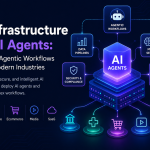
Artificial intelligence gets most of its attention at the surface. We talk about smarter models, AI agents, automated customer service, recommendation engines, medical analysis, and generative content. Yet the part that often determines whether any of those ideas actually work in the real world sits underneath them: AI Infrastructure.
Think of the model as a high-performance engine. The infrastructure is the chassis, fuel system, cooling, road network, dashboard, security system, and maintenance crew. Put a brilliant engine into a weak car and you have not created a supercar; you have created an expensive problem.
That distinction matters even more as organizations move beyond small AI experiments. Production AI has to handle changing workloads, move large amounts of data, deliver responses quickly, recover from failures, control costs, protect sensitive information, and keep models observable after deployment. Google Cloud’s architecture guidance similarly notes that the performance, cost, and scalability of AI and machine-learning applications depend directly on the underlying compute, storage, and networking environment.
That is where the base infra for AI infrastructure becomes important. It includes far more than GPUs. A production-ready foundation connects compute, storage, high-speed networking, data systems, orchestration, model serving, security, monitoring, and governance into one coordinated environment. NVIDIA similarly describes enterprise AI infrastructure as a stack spanning infrastructure software, GPU management, orchestration, model deployment, and application tooling across cloud, data center, and edge environments.
What AI Infrastructure Actually Includes
AI infrastructure is the technical environment used to develop, train, deploy, operate, and monitor AI systems. In practice, it is best understood as a set of connected layers rather than a single product.
GPUs are especially important because AI workloads often involve highly parallel computation. Kubernetes, for example, provides stable mechanisms for scheduling GPUs through device plugins, allowing specialized accelerators to be exposed and allocated as cluster resources.
But throwing GPUs at every problem is a little like buying a Formula One car for the school run. Some inference workloads can operate efficiently on CPUs or smaller accelerators, while large-model training may require tightly connected clusters of powerful accelerators. Microsoft specifically recommends choosing computers according to the workload and notes that CPU resources can still be appropriate for some smaller inference tasks.
Building AI Infrastructure for Scale and High Performance
Scalability does not mean purchasing the largest possible cluster on day one. It means designing an environment that can expand or contract as demand changes without forcing you to rebuild the architecture.
For inference systems, the central balance is usually between latency, throughput, capacity, and cost. AWS recommends measuring metrics such as time to first token, request latency, requests per second, token throughput, GPU utilization, and cache utilization when operating generative-AI inference workloads.
Dynamic scaling matters because AI traffic is rarely perfectly predictable. AWS guidance recommends right-sizing compute first and then applying autoscaling so capacity can adapt to demand rather than leaving expensive accelerators idle indefinitely. It also warns that scaling introduces practical problems such as model-loading time, container startup delays, and hardware availability.
Optimize the whole pipeline, not just the accelerator.
A fast GPU waiting for model weights to arrive from slow storage is still waiting.
Similarly, distributed training and large-scale inference depend on efficient communication between systems. Google describes current large GPU environments as integrated compute systems in which accelerators, high-bandwidth networking, monitoring, scheduling, and recovery mechanisms must work together.
Reliability deserves equal attention. At scale, failures are no longer unusual exceptions. Hardware can degrade, nodes can disappear, software can crash, and dependencies can become unavailable. Production environments therefore need health monitoring, automated remediation, workload rescheduling, redundancy, backups, and checkpointing strategies appropriate to the workload. Google explicitly recommends moving from reactive troubleshooting toward continuous telemetry, automated detection, and remediation for large AI clusters.
Observability then closes the loop. Modern AI monitoring goes beyond ordinary CPU and memory dashboards. AWS CloudWatch, for example, supports monitoring AI-specific signals including invocation latency, error rates, throttling, token usage, model interactions, and end-to-end traces across models, tools, and knowledge components.
Security Must Be Part of the Foundation
Security is where AI infrastructure stops being merely an engineering concern and becomes a business concern.
AI systems combine familiar cybersecurity risks with additional concerns surrounding training data, model behavior, AI supply chains, generated content, and model misuse. NIST’s Generative AI Profile recommends integrating risk management throughout the AI lifecycle, including governance, pre-deployment testing, incident processes, data considerations, and ongoing evaluation.
CISA takes a similar position through its Secure by Design approach: security should be treated as a fundamental product requirement rather than an optional feature added after deployment. Its international guidance for AI development organizes security across secure design, development, deployment, and ongoing operation.
For infrastructure teams, that translates into several practical controls: strong identity management, least-privilege permissions, private networking where appropriate, encryption, secret management, workload isolation, protected storage, audit logs, vulnerability management, and continuous monitoring. Google’s current generative-AI security guidance applies controls across the entire stack, from enterprise identity and networking through compute, containers, data, models, inference systems, agents, and applications.
Security boundaries become particularly important when teams or customers share infrastructure. Kubernetes documentation notes that multi-tenant clusters introduce risks around security, fairness, resource contention, and “noisy neighbors,” and recommends measures including role-based access control, quotas, network policies, and stronger isolation where appropriate.
AI Infrastructure for Healthcare, Ecommerce, Media, and SaaS
The same core infrastructure principles apply across industries, but priorities change depending on what the AI system is expected to do.
| Industry | Typical AI needs | Infrastructure priorities |
| Healthcare | Clinical support, document processing, medical imaging, administrative AI | Sensitive-data protection, auditability, access control, reliability |
| Ecommerce | Recommendations, search, customer support, personalization | Low latency, rapid scaling, real-time data, cost-efficient inference |
| Media | Content analysis, personalization, generation, rendering, metadata | High-throughput compute, large storage, GPU acceleration, content delivery |
| SaaS | AI assistants, automation, analytics, embedded AI features | Multi-tenancy, tenant isolation, autoscaling, predictable performance |
In healthcare, infrastructure design must account for the sensitivity of patient information. In the United States, the HIPAA Security Rule requires covered entities and business associates to apply administrative, physical, and technical safeguards to electronic protected health information, including access and audit-related controls.
That means AI infrastructure handling regulated health information cannot treat security controls as decoration around the model. Data access, storage locations, logs, backups, encryption, permissions, and third-party services all become part of the compliance architecture. Cloud providers also make clear that using a HIPAA-eligible service does not automatically make an organization’s complete AI solution compliant; customers remain responsible for configuring and operating their environment appropriately.
For ecommerce, speed and personalization move to the foreground. A modern recommendation workflow can ingest clickstream behavior, process customer and catalog information, retrieve relevant context, generate personalized results, and cache responses to improve cost and performance. Google’s retail reference architecture demonstrates precisely this pattern.
Payment data requires another security boundary. PCI DSS provides technical and operational requirements for organizations that store, process, transmit, or can affect the security of payment-card data environments. AI systems connected to ecommerce environments therefore need carefully designed separation between AI workloads and sensitive payment systems.
In media, workloads may combine personalization with computer vision, generative AI, rendering, transcription, search, and video processing. AWS describes media AI deployments spanning personalized experiences, content enrichment, visual-effects workflows, real-time information products, and large-scale media processing.
And for SaaS, multi-tenancy becomes central. Infrastructure may need to serve thousands of customers while ensuring one customer’s activity cannot consume resources or expose information belonging to another. Kubernetes specifically identifies SaaS as a common multi-tenant deployment model and describes resource quotas, network isolation, namespaces, and stronger control-plane separation as possible safeguards.
Choosing the Right Base Infra for AI Infrastructure
A good AI infrastructure strategy begins with requirements rather than hardware shopping.
Start by asking what you are actually running: model training, batch inference, interactive inference, retrieval-augmented generation, multimodal processing, AI agents, or several of these together. The answer changes your requirements for compute, storage, networking, scaling, and resilience. AWS’s production inference guidance and Microsoft’s AI architecture patterns both recommend designing around workload characteristics rather than treating every AI application identically.
Next, define the service expectations. How quickly must the system respond? What happens if it goes offline? Which data can it access? Where may that data legally reside? How much traffic variability must it absorb? What level of tenant isolation is required?
Only then should you decide between managed cloud services, self-managed cloud infrastructure, on-premises systems, or a hybrid approach.
Managed services generally reduce operational burden, while infrastructure level deployments provide greater control over models, runtimes, hardware, networking, and compliance boundaries. Microsoft explicitly frames infrastructure level AI as a deliberate option for organizations requiring deeper customization, data-location control, specialized performance, or HPC integration and notes that this additional control also brings additional operational responsibility.
Finally, design for change. Models will change. Accelerator generations will change. User traffic will change. Regulations and security expectations will evolve. Your architecture should make those changes manageable rather than turning every upgrade into digital archaeology.
Frequently Asked Questions
What is AI infrastructure?
AI infrastructure is the combination of compute, storage, networking, data systems, orchestration, model serving technology, security controls, and monitoring needed to build and operate AI applications. Cloud architecture providers treat these components as an interconnected system because infrastructure decisions directly affect AI performance, scalability, reliability, and operating cost.
Why are GPUs commonly used in AI infrastructure?
GPUs are designed to perform many calculations in parallel, making them well suited to numerous AI training and inference workloads. However, not every application requires the most powerful GPU available; CPU and alternative accelerator options can make more sense for smaller or differently optimized workloads.
How can businesses make AI infrastructure more secure and scalable?
Security and scalability work best when designed together. Organizations should apply least-privilege access, strong identity controls, encryption, network isolation, monitoring, secure software practices, resource quotas, autoscaling, redundancy, and AI-specific risk management throughout the system lifecycle.
Conclusion: Build the Foundation Before You Chase the Future
AI has a habit of making the visible part look easy. A polished chatbot can appear effortless. A recommendation engine may return an answer in milliseconds. A media application can generate or analyze content with a click.
Behind that simplicity sits infrastructure doing the less glamorous work: allocating compute, moving data, enforcing permissions, loading model weights, isolating tenants, scaling services, recording logs, recovering from failures, and watching every layer for trouble. Modern cloud and infrastructure guidance increasingly treats AI as a full-stack engineering discipline rather than a model running in isolation.
That is why AI Infrastructure deserves to be considered early in any serious AI strategy.
The right foundation gives you room to scale without rebuilding everything, performance without uncontrolled spending, and security without trying to bolt protections onto a finished system. Just as importantly, it gives your teams visibility and control when AI moves from an impressive demonstration to something customers, employees, or patients actually depend on.